
Critical raw materials are fundamental resources for today’s economic development and technological transformation. They are essential for industries such as battery manufacturing, renewable energy production, electronics, the automotive industry, defence technologies and digital infrastructure. Ensuring secure and sustainable access to them is therefore not merely an industrial issue, but also an economic factor of strategic importance for competitiveness and security of supply.
Research into critical mineral raw materials helps us gain a better understanding of domestic and EU raw material potential, reduce import dependence, and make informed decisions on sustainable extraction, recycling and resource management. Their social role is also significant: they support the green transition, energy independence, job creation and regional development, while their research requires a responsible environmental approach and broad professional cooperation both domestically and across the EU.
According to Article 19 of Regulation (EU) 2024/1252 of the European Parliament and of the Council establishing a framework for ensuring a secure and sustainable supply of critical raw materials and amending Regulations (EU) No 168/2013, (EU) 2018/858, (EU) 2018/1724 and (EU) 2019/1020 (the CRM Regulation), Member States are required to develop national exploration programmes for the identification of domestic CRM resources in order to establish internal raw material production capacities within the European Union.
In the EU, the preparation and implementation of National Exploration Programmes are carried out by geological surveys; accordingly, in Hungary, this task falls within the remit and competence of the Geological Survey of the SARA. As the body responsible for carrying out state geological tasks, the Geological Survey is the institution designated to prepare and systematically implement this national exploration programme, by bringing together and coordinating related partners — universities and research institutes — and with the necessary governmental support and cooperation. In this regard, we are conducting continuous consultations with the relevant ministries.
Continuing the innovation of the Budapest Geothermal Exploration Program, we have established the CRM National Roundtable to prepare a coherent, agile programme running until 2030, with the involvement of Hungarian geoscience experts engaged in raw material exploration. The Roundtable includes all universities offering geoscience education — ELTE, Miskolc and Szeged — as well as the relevant ministries, Nitrokémia Zrt. and Mecsekérc Zrt.
The CRM Roundtable enables us to channel the needs and experience of public administration, academia, society and industry into the National Exploration Programme, so that the scientific results intended to be achieved by the programme can generate the greatest possible spill-over effect. Our aim is to establish lasting competencies and achieve scientific results capable of moving domestic raw material exploration in a sustainably prosperous direction.
For each project, the main exploration objective is de-risking, i.e. reducing geological risk, thereby making the utilisation of individual raw material occurrences interpretable on a market basis for potential future investors.
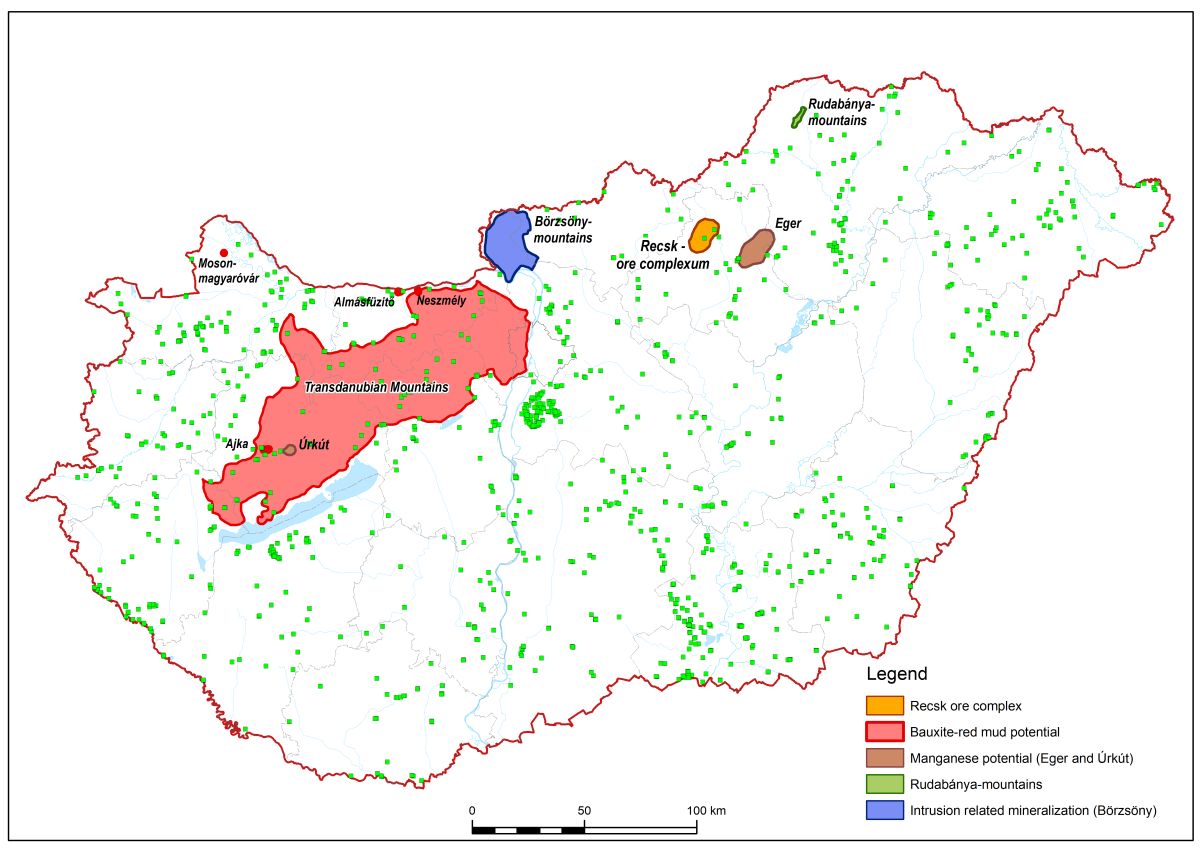
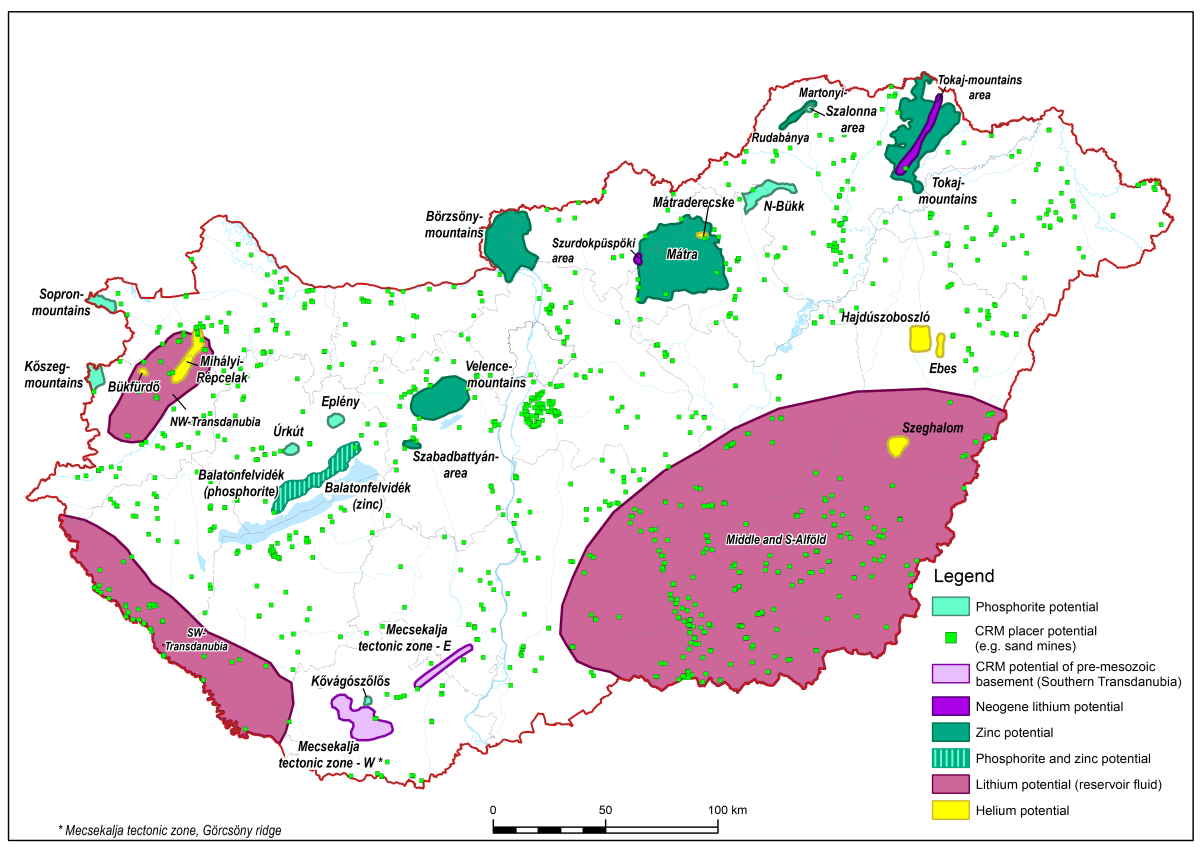
The 12 exploration projects proposed in the National Exploration Programme are:
- Exploration of the copper and other critical raw material potential of the Recsk ore complex
- Critical element potential of Hungarian bauxites and red mud
- Critical element content of Hungarian manganese ores
- Critical raw material potential of the Rudabánya Hills
- Critical raw material potential of bismuth-rich mineralisation associated with intrusive activity
- Exploration of phosphorite and phosphate-related rare earth element occurrences
- Exploration of critical raw materials in placer accumulations in Hungary
- Critical raw material potential of the pre-Mesozoic basement of Southern Transdanubia — titanium, cobalt, nickel and precious metals
- Reconnaissance exploration of lithium enrichments in Hungary’s Neogene volcanic areas
- Critical raw material potential of Hungarian zinc ores
- Lithium potential associated with geothermal and oilfield co-produced fluids
- Hungary’s helium potential
CRM contact: foldtaniszolgalat@sztfh.hu